
Repair
What you do after you react makes the difference in your relationships.

It happened fast. Too fast for me to notice what was building underneath.
A week of bad sleep. Work pressure sitting heavy. That quiet guilt in the background that I did not have time to prepare my daughter for her test.
Saturday evening, I finally sit down with her. We open the exercises. She looks at them and says, “Oh, I do not want to do this one.”
And something in me snaps. I react strongly. Too strongly. I tell her that tomorrow there will be no phone. No seeing her friend.
I can see it land. She gets upset. She pushes back. Says it is unfair. Says she wants to study.
And she is right. But I am not there anymore. I am not responding to her. I am responding to my exhaustion. My stress. My guilt. Everything I did not process during the week.
It all lands on her.
We both get stuck in it. For almost an hour, neither of us can regulate. She struggles to fall asleep. And I sit there knowing something is off, but not yet able to reach it.
The next morning, she tells me she is still upset. I expected that.
This is the moment that matters. Not the reaction. The repair.
I take her out for breakfast. Just the two of us. And I come prepared. Not with a perfect script. But with ownership.
I tell her:
“Hey, I want to talk for a minute about yesterday evening.”
“I was really frustrated about the exercises and I reacted strongly. I am sorry for how it went.”
“You were not in the mood, and then I said you could not see your friend and no phone. That must have felt really unfair and upsetting.”
“I love you and we are ok even when we get angry with each other.”
“Parents also make mistakes when they are frustrated. I am still learning too. I was stressed and tired and I overreacted. It is not your fault.”
I add something that matters to me.
“My mother never talked to me after a fight. I always thought it was my fault. I want you to know this is not your fault.”
And then something shifts.
We are walking.
She stops.
She hugs me. “I love you, mami.”
And then she tells me how unfair it felt.
Now I can hear her.
Now she can speak.
The sky clears.
We talk about what I need that day.
We talk about what she needs.
We make a plan.
Connection is back.
This is the part we do not talk about enough.
We focus so much on not reacting.
On staying calm.
On getting it right in the moment.
But the truth is:
You will react. You will work on it, get better at it. And still, it will happen.
You will have moments where you are tired, overloaded, and not fully aware of what is driving you.
That is part of being human. The difference is not perfection. The difference is repair.
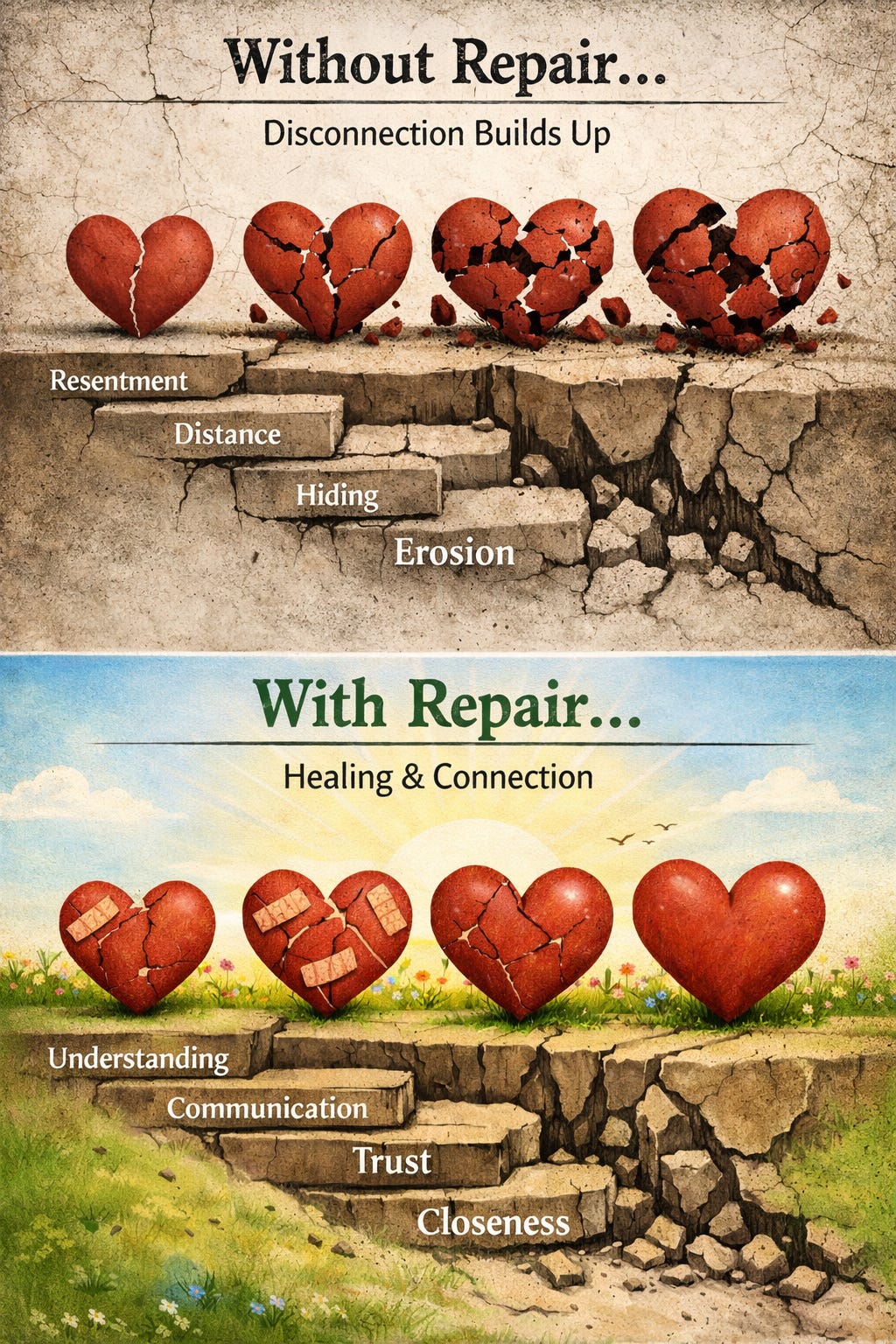
Without repair, small breaks stay open. They turn into distance. Into hiding. Into resentment. Over time, the relationship erodes. Not because of one moment. But because no one comes back to close it.
With repair, something else happens. The break is acknowledged. Responsibility is taken. The other person is seen. And the connection becomes stronger, not weaker. Repair does not erase what happened. It transforms it.
I used to take my close relationships for granted.
My daughter. My husband.
I thought they would just hold. But relationships are not maintained by intention. They are maintained by what we do after it goes wrong.
Repair is not a nice extra. It is the work.
You are allowed to be human and react. And you are responsible to repair.
If you are ready to work on managing your reactions, there is space to do that together.
Join me in the Lead with Presence: Manage Your Emotions workshop on April 16th.
I believe in you,
Andra